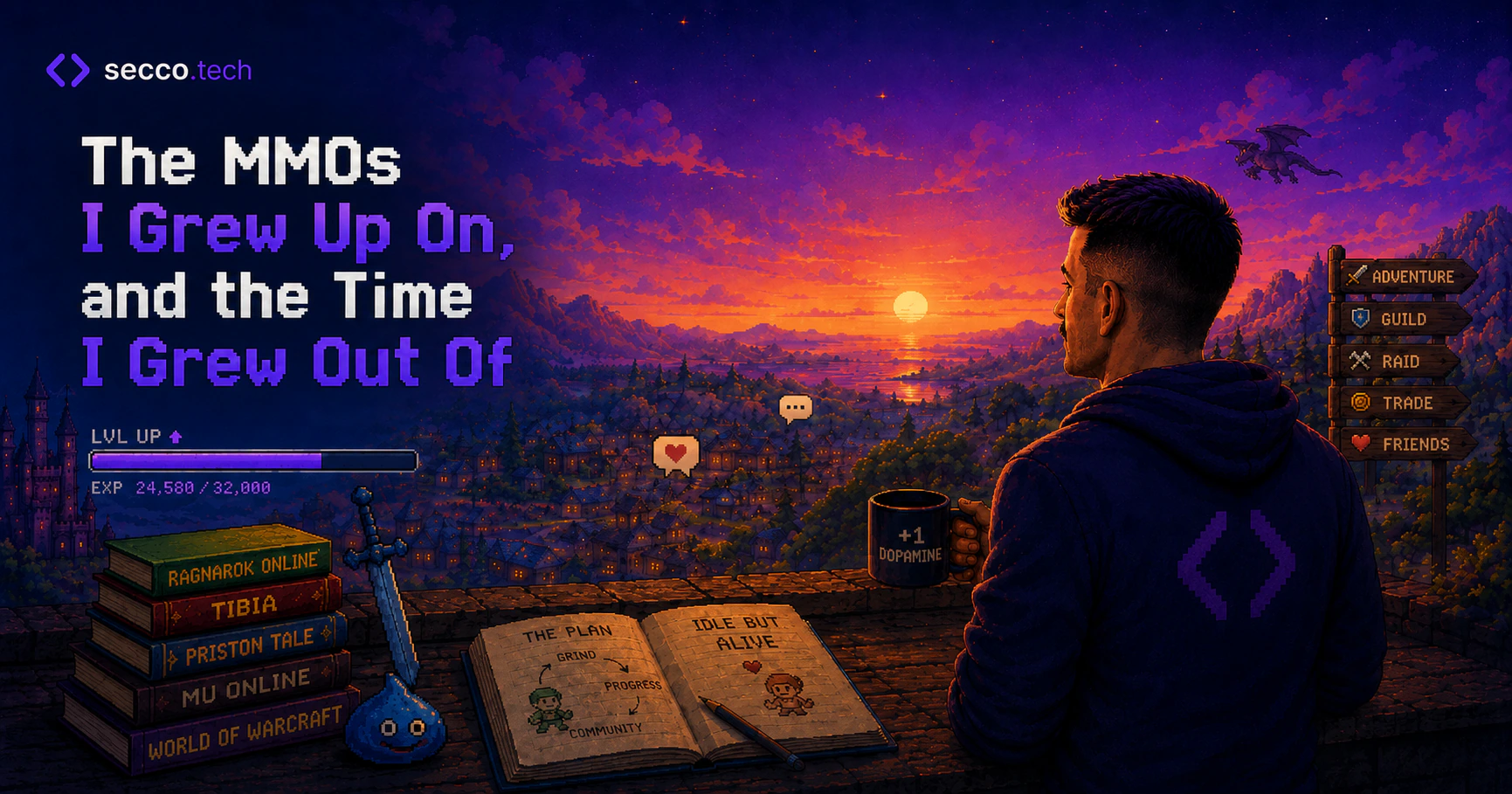
The MMOs I Grew Up On, and the Time I Grew Out Of
I have loved videogames for as long as I can remember, and for most of that time I loved one kind above all others: the MMORPG. Not for the graphics or the loot, exactly — for the world. Being able to walk around inside one, to bump into other people, to duel a stranger over a patch of forest, and above everything else, to watch a character that was mine grow stronger the more of myself I poured into it. As a teenager, that progression felt almost holy. Every level was proof that the hours had counted for something.
What nobody tells you at fourteen is that the currency those games run on is time — and that you happen to be, at fourteen, obscenely rich in it. I had entire summers to spend grinding the same monsters on the same map, and I spent them gladly.
Then you grow up. The hours that used to go into getting strong now go into the things adult life quietly insists on: work, a family, your health, the sleep you actually need. I didn't fall out of love with MMOs. I ran out of the one thing they ask for. And I know I'm not alone — this is, more or less, the story of everyone I know who grew up inside those worlds.
The genre grew up too — badly
Here's the strange part: while we were losing our time, the games were losing their nerve.
In the scramble to reach everyone, MMOs sanded away the very friction that made the grind mean something. You fast-travel everywhere. You follow a quest marker to a glowing dot. You do most of it alone until some far-off "endgame." The danger, the interdependence, the sense that the world could bite back — a lot of it got streamlined out in the name of convenience. Talk to people who still love the genre and you'll hear the same eulogy on repeat: the era of the MMO is over. Whether it's dead or merely dying is, apparently, the only argument left.
So there were two curves bending away from each other. The games shed the parts that demanded time; I shed the time itself. We met in the middle at "I guess I don't really play those anymore."
The genre that was waiting for the person I became
And then, almost by accident, I found the counter-current: idle games.
If you've never fallen down this particular hole: idle (or "incremental") games are built so that progress keeps happening whether or not you're looking at them. You set something in motion, close the tab, come back later, and you're stronger. It sounds like it shouldn't be fun. It absolutely is.
The genre more or less began with Cookie Clicker in 2013 — a browser toy its creator reportedly built in a single afternoon, played over a million times in its first week, that accidentally defined a category. It grew into mainstream juggernauts like AdVenture Capitalist (50M+ downloads, a lemonade stand you compound into an empire). And it is very much not a relic: earlier this year Taskbar Hero, a tiny idle RPG that literally lives in your Windows taskbar, became one of 2026's breakout hits. Its all-time concurrent peak hit 546,130 players — briefly the third most-played game on all of Steam, behind only Counter-Strike 2 and Dota 2, ahead of the likes of Apex and PUBG. For a free idle game. Within three weeks of launch. It got so popular that its tradable items set off a gold-farming gold rush large enough to overwhelm Steam's own marketplace — the developer had to restrict, and then temporarily shut down, item trading just to keep the servers standing. An idle game did that.
For the last few weeks I've been playing Taskbar Hero and a browser game called pokeidle, where your Pokémon wanders off on its own to hunt and train — basically a Pokémon-skinned take on the old auto-hunting MMOs — and, to my genuine surprise, it is deeply, quietly satisfying. It scratches the exact itch the MMOs used to: numbers going up, a thing that's mine getting stronger. It just doesn't ask for the hours I no longer have to give.
There's a smarter, more cynical reading of all this — I read a lovely essay arguing that idle games are really overwork bleeding into leisure, that optimizing fun down to zero required time is "the true death of work-life balance." I understand the worry. But for me it lands the other way around. Idle games didn't steal my time. They fit into the little of it I have left — and handed back a hobby I'd quietly filed under "things I used to do."
So I started building one
Playing pokeidle, one game kept surfacing from memory: a grind-heavy MMORPG I sank whole years into as a teenager — the kind of game people love so much that they still keep their own servers running for it, long after the world moved on. I don't get to live in it anymore. I miss it anyway.
So I've started building something for the version of me who exists now: an idle game that recreates that hunt-and-grind loop in the browser — the small, specific joy of opening a tab to find your character stronger than you left it.
It's early; right now it's more of a personal prototype than a product. But I'm not building it only as a nostalgic — I'm building it as someone who ships things. The plan is to bring back the parts that made those worlds worth living in: real multiplayer, chat, trading, guilds, group raids — the social gravity that turns a grind into a place. And, yes, to build it so it can support itself. There'll be a VIP tier and boosts — the honest kind that respect a player's time instead of holding it hostage. If I'm going to ask people to make a home somewhere, I want it still standing in five years, and that means it has to earn its keep.
I'm not trying to rebuild the MMOs of my teens. I couldn't, and I'm not sure I'd want to. I'm trying to keep the feeling they gave me — steady progression, a character that's unmistakably yours, a world that keeps turning even when you look away — and fit it into the life I actually have.
The grind grew up. Maybe it can grow up with me.